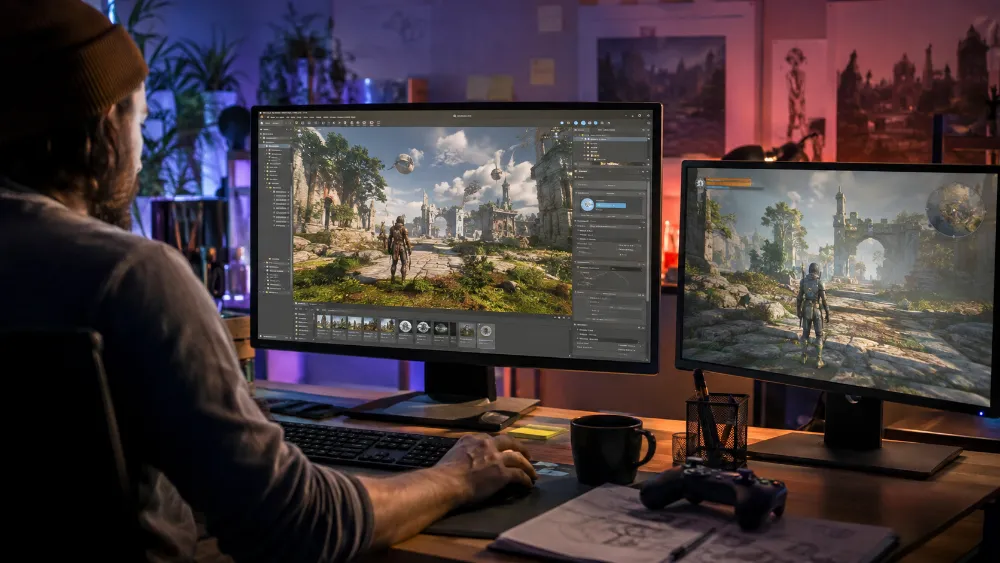
2020 — Unity 3D Game Development Learning Path
Focus: Unity 3D, C#, 2D/3D Game Logic, Physics & Interactive Systems
Learning Format: Multiple Udemy courses and hands-on practice projects
Why I Started
In 2020, I decided to learn game development even though I already knew that traditional coding was not naturally my strongest area.
I still wanted to understand how real interactive software worked, so I started learning Unity 3D and C# through multiple structured courses and practical projects.
Very quickly, I learned something important: game development is rarely just “write some code and make a game.” It is a combination of programming, design, animation, physics, assets, sound, testing and level building. It also taught me why professional games are usually built by teams with different specialists rather than one person doing everything.
Learning C# Through Real Game Logic
I learned C# by connecting code to actual game objects rather than studying the language only in theory.
I worked with both 2D and 3D assets, wrote scripts behind them, connected behavior to player input and tested whether the game world behaved logically.
- Player movement and controls
- 2D and 3D object interaction
- Collision detection
- Physics and gravity
- Game-object relationships
- Triggers and events
- Doors and conditional access
- Walls and physical boundaries
- Health/life systems
- Shooting mechanics
- Object placement and level logic
- Testing and debugging gameplay behavior
Understanding How a Virtual World Has to Behave
One of the most interesting parts of learning Unity was realizing how much logic is required just to make a world feel normal.
A player should stand on a surface instead of falling through it. A wall should block movement. A doorway should only become passable when the door actually opens. Objects need colliders, physics settings and relationships that make sense inside the scene.
I learned how 3D objects, lighting, reflections, surfaces and physics work together to make an environment believable rather than just visually present.
Building 2D & 3D Games
I created multiple small 2D and 3D games using professionally designed asset packs so I could focus on learning game logic, code and implementation.
I also built a basic shooting game with weapon/shooting behavior and player life functionality. These projects gave me hands-on experience connecting visual assets with working code rather than only following programming exercises.
Mobile vs PC Game Thinking
I also learned that mobile and desktop games are not simply the same project exported to a different device.
The controls, input methods, performance limits, interface decisions and player experience can change significantly between mobile and PC. That helped me think more seriously about platform constraints and how software should be designed for the environment where people will actually use it.
The Bigger Lesson: Development Is Teamwork
Game development changed how I thought about technical projects.
I saw clearly that strong software is often the result of several disciplines working together:
- Developers building systems and logic
- Designers creating visual direction and assets
- 3D artists and animators producing environments and characters
- Level designers shaping the experience
- Testers finding gameplay and technical problems
- Sound and music specialists completing the environment
That lesson later became useful far beyond games. It helped me understand why web apps, websites, automation systems and digital products also become stronger when design, development, business logic and testing work together.
Why I Did Not Continue Professionally
I enjoyed the learning process and proved to myself that I could understand and build working game systems, but I did not find a realistic professional path into the industry at that time.
From my own search in Lahore, I found very few studios, internships or entry-level opportunities that gave me a clear route into professional game development. Instead of continuing indefinitely without a practical opportunity, I kept the work as part of my technical portfolio and moved my focus toward fields where I could find stronger business and career opportunities.
What I Took Forward
I did not become a professional game developer, but the experience was far from wasted.
Unity taught me how to think about events, state, user input, physics, conditional behavior, debugging, object relationships and system logic. Those same ways of thinking later helped me understand web development, automation workflows, APIs and interactive software more quickly.
Most importantly, it proved something to me early: I could learn technical systems even when they did not come naturally at first.
Skills Demonstrated
Unity 3D · C# · 2D Game Development · 3D Game Development · Game Physics · Collision Systems · Player Controls · Shooting Mechanics · Health Systems · Triggers · Interactive Objects · Game Testing · Debugging · Mobile vs PC Design Thinking · Technical Learning