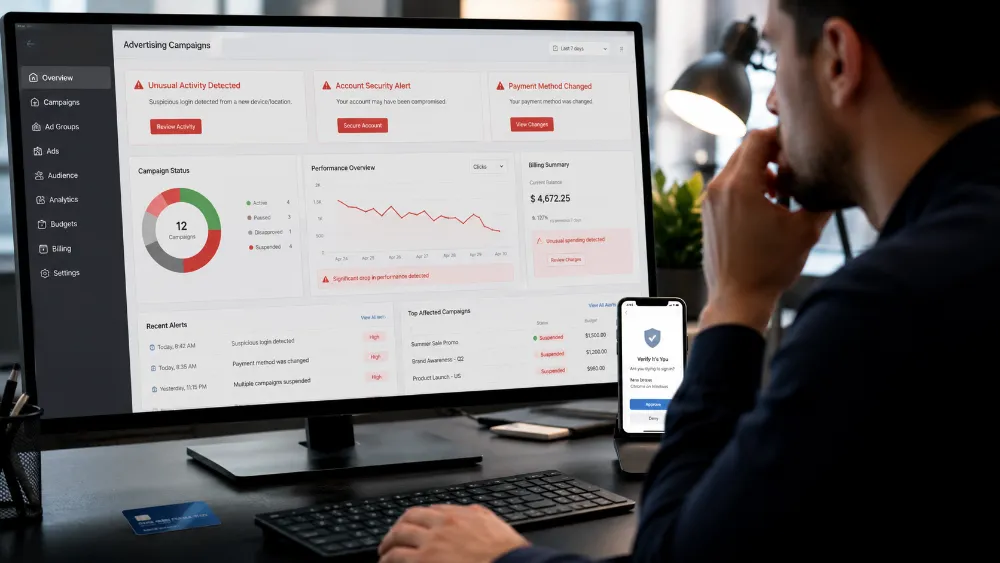
Meta Ads Account Recovery — Responding to a Real Ad Account Compromise
Role: Meta Ads Manager, Client Account Operator & Incident Coordinator
Platform: Meta / Facebook Ads
The Incident
One of the most serious Meta Ads problems I have handled was not a bad campaign or rejected ad. A client’s live advertising account was compromised by a hacker.
The attacker gained administrative access to the ad account and began using the client’s payment-enabled advertising account to run unauthorized ads.
I could still access parts of the account, but I no longer had enough authority to remove the malicious administrator. The client’s Facebook Page and our normal profiles were still connected, yet the attacker had given their own account direct administrative control over the advertising account.
At that point, this stopped being an advertising task and became a live security and financial incident.
First Priority: Stop Further Financial Damage
Before trying complicated recovery steps, I focused on limiting the client’s exposure.
I advised the client to freeze the payment card connected to the advertising account so the attacker could not continue spending the client’s money.
This disrupted the ad account and eventually contributed to its suspension, but protecting the client’s funds was more important than keeping campaigns active while an unauthorized party still had control.
The Hard Part: I Could See the Account but Could Not Remove the Hacker
This was the most frustrating part of the incident.
I was still connected to the client’s Meta assets, but normal account permissions were not enough to remove the attacker’s direct administrative access.
I tried the available recovery and permission routes, gathered account information, checked connected assets and repeatedly contacted Facebook/Meta support.
This required persistence because the problem could not be solved with a normal password reset. The issue involved Business/Ad Account permissions and ownership-level access.
Escalating Through Meta Support
I sent multiple support requests and provided the information Meta requested to confirm that we were the legitimate account operators.
The first support representative investigated the issue and requested additional verification, but they were also unable to remove the unauthorized access through the tools available to them.
Instead of closing the case, the issue was escalated to a higher support level.
The next support representative also attempted to correct the account permissions from their side. We both reached a point where the normal support controls were not resolving the issue. At the time, I suspected there may also have been a platform-side permissions or software problem, although I could not independently confirm that.
From Support Ticket to Live Recovery Call
The case eventually moved beyond email and chat support.
A Meta support representative arranged a call with me and guided me through the account step by step while we investigated the permissions together.
Because the required changes could not be completed entirely from Meta’s side, the representative asked me to share my screen and establish a controlled remote-support session.
We worked from both sides of the account: I performed actions available through the client interface while the support representative handled the platform-side steps available to Meta.
After a long recovery process, the unauthorized administrator was finally removed and control of the advertising account was restored.
What Made This Experience Different
This experience taught me that managing advertising is not only about audiences, creatives, budgets and ROAS.
When client advertising infrastructure is connected to real payment methods, Pages, Business accounts and customer acquisition, account security becomes part of advertising operations.
The incident required several different skills at the same time:
- Recognizing that the problem was an account compromise rather than a normal ads issue
- Acting quickly to limit unauthorized financial spending
- Understanding Meta asset and permission relationships
- Preserving access while avoiding actions that could make recovery harder
- Gathering enough information to prove legitimate ownership
- Communicating clearly with platform support
- Persisting through multiple support levels instead of abandoning the case
- Working live with support during a screen-sharing recovery session
- Coordinating technical recovery with the client
What I Learned
1. Stop the financial risk first.
If an advertising account with an active payment method is compromised, protecting the client’s money is more important than keeping campaigns running.
2. Platform access is not the same as administrative control.
Being able to open an account does not mean you still have enough permission to secure it. Business Manager, Page, ad account and payment permissions can behave very differently.
3. Security has to be designed before an incident.
Strong passwords alone are not enough. Roles, administrator access, authentication, payment controls and recovery ownership all matter.
4. Support escalation is a skill.
When first-level support cannot solve a serious issue, the job is not to repeatedly send the same message. The problem has to be documented clearly enough to move to the people with deeper access.
5. Keep the client calm and focused on the next safe action.
During an account compromise, the client does not need panic. They need clear instructions: secure payment methods, preserve evidence, avoid unnecessary changes and follow the recovery process.
6. Marketing systems are operational systems.
An ad account can hold payment methods, audiences, business assets, conversion data and years of campaign history. Losing control can become a real business incident.
How It Changed My Meta Ads Practice
After this experience, I became much more careful about the operational side of paid advertising.
I pay attention not only to campaign settings but also to who has access, which account owns the assets, how payment methods are controlled, whether administrators are still necessary, and how the business would recover if access were compromised.
This experience also strengthened a wider lesson I now apply to websites, hosting, automation and client systems: good implementation includes a recovery plan for when something goes wrong.
Result
The attacker was ultimately removed from the client’s Meta advertising account and legitimate control was recovered after multiple support escalations and a live support session.
For me, the value of this incident was not merely getting an ad account back. It proved that I could remain useful during a stressful client security problem, make sensible risk decisions, work with platform support and continue until the underlying access issue was actually resolved.
Skills Demonstrated
Meta Ads Operations · Meta Business Account Management · Account Security · Incident Response · Permission Troubleshooting · Payment Risk Control · Client Communication · Support Escalation · Account Recovery · Business Asset Management · Security Awareness · Operational Problem Solving