AI Automation — Research-Verified WordPress Event Renewal System
Role: AI Automation Builder, n8n Workflow Architect, WordPress Developer & Technical SEO Operator
Business: Media Print UAE — Dubai Printing & Exhibition Services
Core Stack: n8n, WordPress REST API, AI/LLM APIs, Google Search, Structured JSON, Search Console, Custom WordPress Event Meta
The Business Problem
Media Print UAE serves Dubai businesses and exhibitors, so the website contains dedicated event pages for major exhibitions and trade shows.
Those pages are useful only while the information stays current.
An event that was correct in 2025 may have different dates, venue details, organizer information or search intent in 2026. If old event pages are left untouched, the website slowly accumulates stale content. If they are manually rebuilt every year, maintenance becomes repetitive and expensive.
I wanted an automation that could keep these event pages useful without redesigning them and without trusting AI enough to freely rewrite production content.
The Original Idea Sounded Simple
The first version of the idea was:
Find an old event → research the next edition → update the WordPress page.
In practice, that became much harder.
The real challenge was not finding a date. The real challenge was making sure an AI system could update a live SEO page without mixing events, inventing facts, corrupting existing rankings or confidently publishing weak research.
Step 1 — Find the Event That Actually Needs Maintenance
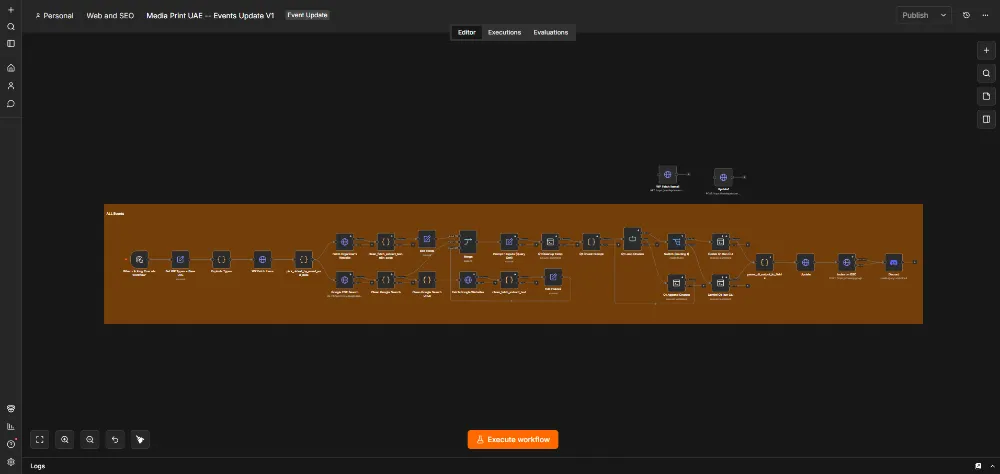
The automation connects to the custom Media Print UAE WordPress event post type through the REST API and reads published event records together with their event metadata.
Instead of choosing an event randomly, the workflow examines each event’s end date and prioritizes the page with the oldest event end date.
This creates a rolling maintenance system:
- Current events are left alone
- The stalest event gets attention first
- AI/search resources are not wasted refreshing pages that are already current
- The event library can be renewed gradually rather than rebuilt in one large batch
Step 2 — Treat Existing WordPress Content as a Starting Point, Not Absolute Truth
The selected event page becomes the base record.
The system reads the current SEO fields, event metadata and page content before generating any update.
This matters because the existing page may contain valuable structure, wording, internal links and SEO equity that should not be destroyed simply because the event year changed.
The operating rule became:
When uncertain, preserve the existing value.
The automation is designed to update only what can be justified by stronger current evidence.
Step 3 — Research the Event From Multiple Sources
The workflow does not ask one model, “When is this event next year?” and trust the answer.
It builds an evidence package from several sources.
- Existing WordPress event data
- The event organizer’s known website
- Google search results
- Selected webpages discovered through search
- Fetched and cleaned page text
The organizer URL stored on the existing event page is attempted directly. Additional search results can then be discovered, filtered and fetched to provide supporting context.
If one webpage cannot be retrieved, the system can record that failure and continue when enough other evidence remains.
Step 4 — Build a Verified Facts Map Before Rewriting Anything
One of the most important improvements was separating verified facts from generated copy.
The workflow can construct a structured facts map containing fields such as:
- Event name
- Event year
- Exact start date
- Exact end date
- Venue
- Address
- City
- Country
Only facts supported strongly enough by the available research should be allowed to replace production values.
Dates Are Treated as High-Risk Data
Event dates are especially dangerous because an AI model will often convert partial information into a confident exact answer.
For example, if a source says an event is happening in “May 2027,” an AI may be tempted to manufacture specific start and end days.
The automation rules became stricter:
- Exact date verified: update it
- Only month/year known: do not invent the missing day
- Conflicting or uncertain evidence: keep the existing value or stop the update
- Verified date stored: normalize it into the expected WordPress date format
Venue and Location Use the Same Logic
A venue is changed only when the newer source clearly supports the replacement.
The same applies to the address, city and other event-location fields.
The purpose of the system is not to maximize the number of changed fields. The purpose is to maximize the number of correctly changed fields.
Step 5 — Refresh SEO & Content Without Touching the Page Design
The Media Print UAE event pages use a custom structured setup, so the automation can update content fields behind the frontend without rebuilding Elementor layouts or changing the visual system.
Depending on the evidence and current page, the workflow can prepare updates for:
- SEO title
- Meta description
- Hero heading
- Hero paragraph
- Why-the-event-matters content
- Relevant Media Print UAE services
- CTA content
- FAQ introduction
- FAQ questions and answers
- Event start/end dates
- Venue name
- Venue address
This separation is important: the automation maintains the data and content layer while the approved page design remains stable.
The First Major Failure — Old Content Can Contaminate the New Update
One of the most valuable discoveries was that existing content is not automatically trustworthy just because it is already published.
Some old event pages contained copied or reused sections from other events.
That created a dangerous failure mode:
If the AI treats all old content as factual context, it can preserve or amplify an old mistake.
For example, an event page could contain FAQ or case-study language inherited from another exhibition. A naive updater might simply rewrite that content more elegantly while keeping the wrong event identity.
The fix was to distinguish:
Existing structure from verified current facts.
Old content can guide tone and layout, but it cannot override stronger current evidence.
The Second Major Failure — AI Likes to Invent Attractive Results
Another problem appeared in marketing-style content.
AI models naturally try to make copy more persuasive. That can become dangerous when the system starts inventing business outcomes, customer results, statistics or testimonials simply because they sound convincing.
That led to explicit content-safety rules:
- Do not invent performance numbers
- Do not invent testimonials
- Do not invent customer outcomes
- Do not claim “largest,” “#1,” “official partner” or similar status without evidence
- Do not manufacture event policies
- Do not turn a vague source into a stronger factual claim
This changed the role of the AI from creative writer to controlled updater working inside an evidence boundary.
The Third Major Lesson — Updating Less Can Be Safer
At first, it is tempting to judge an automation by how much work it changes automatically.
This project taught me the opposite.
If the current value is reasonable and the new evidence is weak, changing the field is worse than leaving it alone.
The safe production rule became:
If verified evidence improves accuracy, update lightly. Otherwise preserve the existing production value.
That is a much stronger design than asking AI to rewrite every field just because a workflow has reached the update stage.
Step 6 — Validate Structured Output Before WordPress Sees It
The AI output is expected to follow a structured JSON contract.
Before production data is written back into WordPress, the workflow checks whether the output can actually be parsed and whether the expected fields are present.
If the AI returns malformed data, an incomplete response or a failed request, the workflow should not “do its best” and continue.
The correct behavior is:
No valid structured result = no production update.
Step 7 — Write the Approved Fields Back Through WordPress REST
Once the update passes the required checks, n8n sends the selected fields back into the same WordPress event record through the REST API.
Because the website exposes the required event meta programmatically, the workflow can maintain the content behind the page while preserving the frontend structure.
This is where my WordPress development work and automation work connect: the website was designed with structured fields that an external system can safely maintain.
Step 8 — Tell Google the Page Has Been Refreshed
After a successful WordPress update, the workflow can continue into a Google Search Console indexing step.
This closes the maintenance loop:
Identify stale page → research → verify → update → request re-indexing.
The automation is therefore not only a content writer. It manages part of the operational lifecycle of an SEO landing page.
Testing Different AI Execution Paths
During development, I experimented with different model/execution approaches, including local AI and API-based models.
This was useful because the task contains two very different workloads:
- Structured extraction and rewriting that may work well with smaller/local models
- Evidence-sensitive reasoning where reliability matters more than saving a small amount of inference cost
I did not want the architecture permanently tied to one model provider. n8n remains the orchestrator so models can be changed or routed differently as the system evolves.
Failure Handling Became Part of the Product
This system is valuable partly because it is designed around what happens when things go wrong.
Organizer website fails:
Record the failure and use other research sources when sufficient evidence remains.
Google result is irrelevant:
Do not treat it as authoritative just because it ranks.
Only partial event dates are available:
Do not manufacture missing days.
Existing page contains another event’s content:
Use verified facts to prevent stale content from contaminating the new version.
AI invents a testimonial, statistic or business outcome:
Reject unsupported claims.
Structured AI response fails:
Stop the update rather than sending malformed data into WordPress.
Evidence is not strong enough:
Preserve the existing value or leave the page untouched.
Why This Is Different From a Normal Content Automation
A normal AI updater optimizes for speed:
Read old page → generate new page → publish.
This system evolved toward a different objective:
Read old page → identify what is actually stale → research current evidence → separate verified facts from old assumptions → update only supported fields → preserve useful existing SEO/content → validate → publish → re-index.
The most important word in the system is not “AI.”
It is verified.
What I Learned
1. Existing production content can contain legacy errors.
Published does not automatically mean verified.
2. AI rewriting is easier than AI restraint.
The difficult part is teaching the system when it should not change something.
3. Structured websites are easier to automate safely.
Custom event fields and REST-accessible metadata allowed the automation to update data without rebuilding page layouts.
4. Research must be separated from persuasion.
An event updater should establish facts before it starts writing marketing copy.
5. A failed run is sometimes the correct result.
Stopping because evidence is weak is better than successfully publishing false information.
6. SEO automation needs preservation logic.
The goal is not to replace everything. It is to protect what already works while correcting what has become stale.
What This Project Demonstrates
This automation combines my experience in WordPress, technical SEO, n8n, AI systems, research workflows and production website maintenance.
It also demonstrates a principle I now use across AI automation:
A production AI system should not only know how to act. It should know when the evidence is too weak to act safely.
Skills Demonstrated
n8n · AI Automation · WordPress REST API · Custom WordPress Meta · Event Automation · Technical SEO · Google Search Research · Google Search Console · Structured JSON · AI Validation · Evidence Verification · Data Preservation · Error Handling · Fail-Closed Automation · Content Updating · SEO Maintenance · API Integration · Production AI Systems